Changing Majors on an F-1 Visa: How it Impacts Your OPT
Switching from Business to Computer Science? Learn how changing your degree program impacts your F-1 status, your I-20, and your future STEM OPT eligibility.
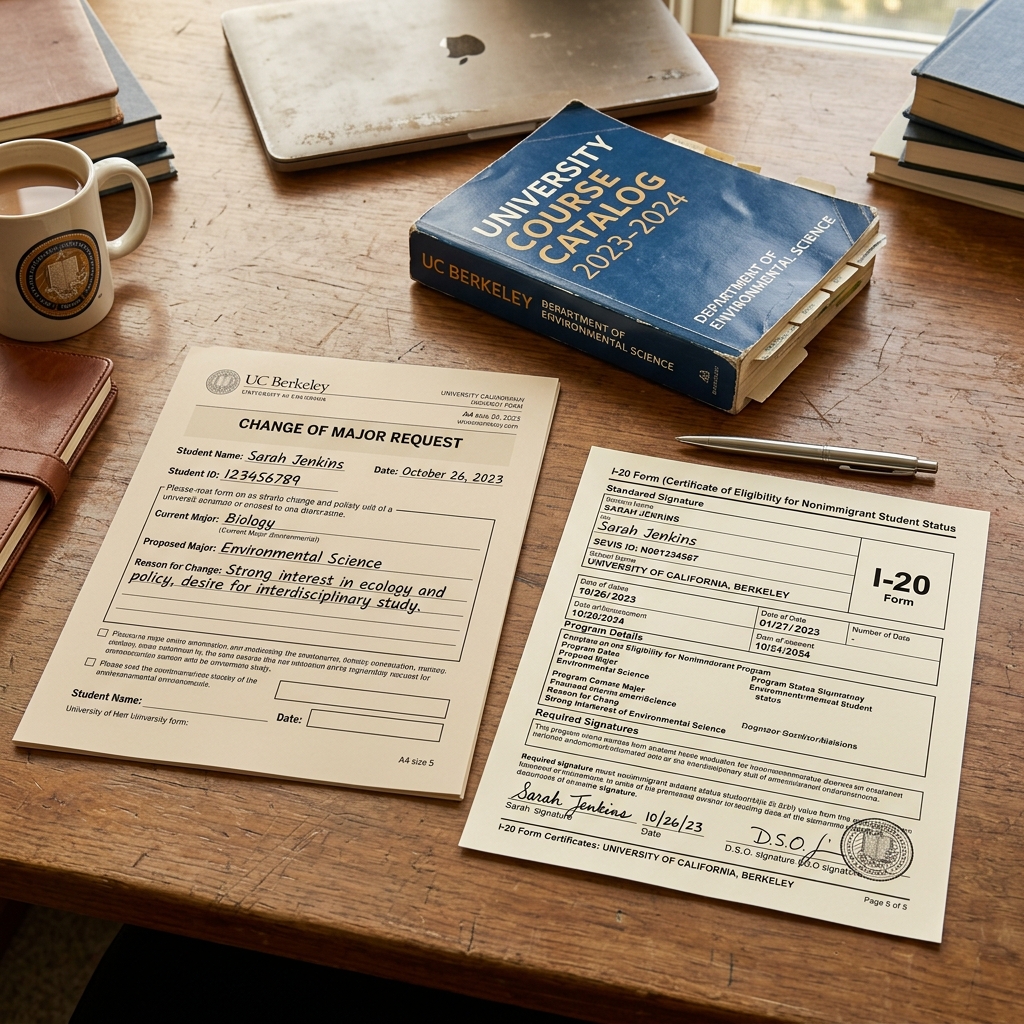
College is a time for exploration. It is incredibly common for undergraduate and graduate students to change their major halfway through their studies. For a domestic student, this just involves filling out a form with their academic advisor. For an F-1 international student, a change of major requires a direct update to the Department of Homeland Security's SEVIS database.
The Legal Requirement to Update SEVIS
Your I-20 document dictates the legal terms of your stay in the United States. On page 1 of your I-20, under the "Program of Study" section, you will see a specific Major 1 and its corresponding CIP Code (Classification of Instructional Programs code).
If you change your major at your university, you must notify your Designated School Official (DSO) immediately. Your DSO is legally required to update your SEVIS record and issue you a brand new I-20 reflecting your new major. If you fail to do this, you are technically studying in a program not authorized by DHS, which is a status violation.
How Changing Majors Affects OPT
Your major is the most important factor in your future Optional Practical Training (OPT). Why? Because DHS strictly mandates that any job you take on OPT must be directly related to your major field of study.
Scenario: The Pivot
Let's say you started as a Marketing major, but halfway through, you switched to Data Science. When you graduate and apply for your 12-month standard OPT, you can only accept jobs related to Data Science. You cannot take a Marketing job, even though you spent two years studying it, because Marketing is no longer the active major on your final I-20.
The STEM OPT Extension Strategy
Many international students intentionally change their major to unlock the 24-month STEM OPT extension. If you are currently in a non-STEM major (like Business Administration or Psychology) and you switch to a STEM-designated major (like Business Analytics or Neuroscience), you extend your total US work authorization from 1 year to 3 years.
Double Majors and STEM
What if you double major? If you have one STEM major (e.g., Mathematics) and one non-STEM major (e.g., Art History), you are fully eligible for the STEM OPT extension—as long as the job you take is directly related to the STEM major. You cannot use a STEM extension to work as an art curator.
CIP Code Verification
Just because a major has the word "Science" or "Technology" in it does not guarantee it is STEM-eligible. You must ask your DSO for the exact CIP Code of your proposed new major, and check that code against the official ICE STEM Designated Degree Program List.
Changing Your Major While on OPT?
Can you change your major after you have already graduated and are currently working on OPT?
No. Your degree has already been conferred. You cannot retroactively change your major to a STEM field just to get an extension. If you want to study a new major, you must enroll in a new degree program, which will require a SEVIS update and will instantly cancel your current OPT authorization.
Keep Track of Your Old I-20s
When you change your major, your school will issue you a new I-20. Do not throw the old one away. When you apply for OPT, the H-1B lottery, or a Green Card, USCIS will ask you to upload copies of every I-20 you have ever been issued.Use TrackMyOPT's Document Safe to securely scan and store all your historical I-20s in the cloud, ensuring you never lose the paper trail of your immigration history.
Step-by-Step: How to Change Your Major
- Speak with your academic advisor to formally change your major within the university's academic system.
- Once approved academically, immediately email your DSO/International Student Office.
- Provide your DSO with proof of the academic change and ask them to update your SEVIS record.
- Pick up your new, reprinted I-20. Ensure the "Program of Study" section reflects the new major and new CIP code.
- Sign the new I-20 in blue ink. Scan it and upload it to your TrackMyOPT Document Safe.
Never Lose an I-20 Again
Every time you change a major, add a minor, or get CPT authorization, you get a new I-20. USCIS requires you to keep all of them. Use TrackMyOPT's Document Safe to securely store your entire immigration history in one place, ready for your OPT application.