F-2 Dependent Visa Rules: What Your Spouse and Kids Can (and Cannot) Do
Bringing your family to the US on an F-2 visa? Understand the strict rules about employment, education, and how your OPT status directly impacts your dependents.
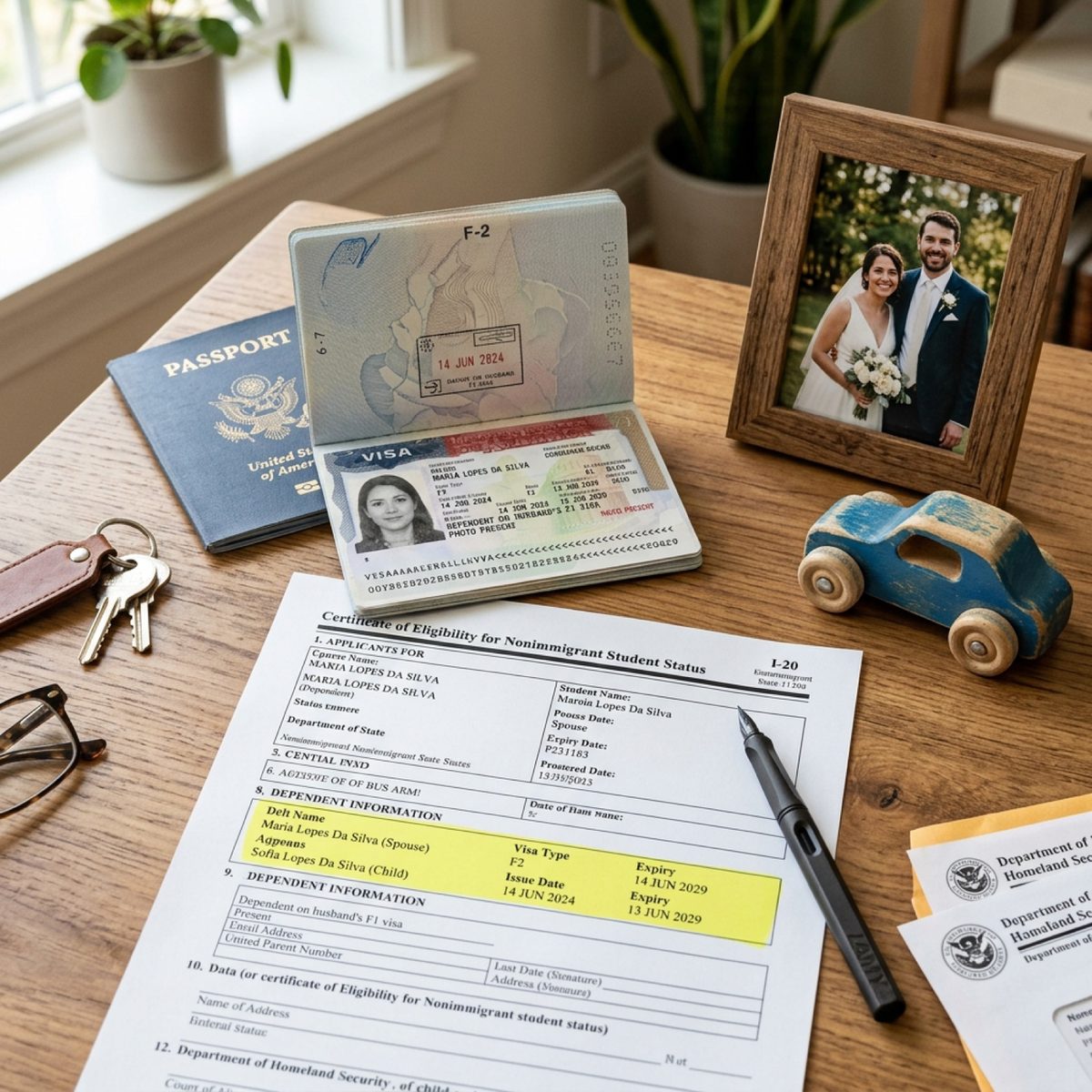
If you are an F-1 international student or OPT holder, you can bring your spouse and unmarried children under 21 to the United States on an F-2 dependent visa. While this lets your family live with you, the F-2 visa comes with significant restrictions that many families are unprepared for.
Quick Reference: What F-2 Dependents Can and Cannot Do
Allowed
- Live in the United States with the F-1 holder.
- Enroll in part-time recreational or avocational study (e.g., a cooking class, yoga, or a single college course for personal enrichment).
- Children can attend K-12 public school for free.
- Open a US bank account.
- Obtain a US driver's license in most states.
- Travel freely within the US.
Not Allowed
- Work. F-2 holders cannot accept any employment, paid or unpaid, under any circumstances.
- Enroll in a full-time degree program (must change to F-1 for full-time study).
- Receive a Social Security Number (SSN) — unless required for a state benefit.
- Freelance or consult, even for a company in their home country.
How to Get an F-2 Visa for Your Family
Your family does not need a separate I-20 for the F-2 visa. Instead, your DSO will update your I-20 to include your dependents in the "Dependent Information" section. The process is:
- Provide your DSO with your marriage certificate and children's birth certificates.
- Show proof that you have sufficient financial resources to support your family in the US (bank statements, scholarship letters, or an affidavit of support).
- Your DSO updates your I-20 with your dependents' information and issues a dependent I-20 for each family member.
- Each dependent applies for an F-2 visa at the US embassy in their home country using their dependent I-20.
What Happens to F-2 Dependents During OPT?
When you graduate and transition from active F-1 student status to OPT, your F-2 dependents remain in valid status as long as your OPT is active. However, there are critical rules to understand:
- If your OPT expires and you do not transition to another visa, your F-2 dependents also lose their status and must depart the US within the 60-day grace period.
- If you violate your OPT (e.g., exceed the 90-day unemployment limit), your SEVIS is terminated, and your F-2 dependents instantly lose their status as well.
- Your spouse's F-2 status is entirely dependent on your compliance. They have no independent immigration standing.
Protect Your Entire Family with TrackMyOPT
Your spouse and children's immigration status depends entirely on your OPT compliance. A single mistake—exceeding unemployment days, missing a SEVIS reporting deadline, or failing to update your employer—can destroy your entire family's legal presence in the US. TrackMyOPT automatically tracks your unemployment counter, sends deadline alerts, and keeps your SEVIS reporting on schedule.
Can an F-2 Spouse Change to F-1?
Yes. If your spouse wants to pursue a full-time degree, they can apply to change their status from F-2 to F-1 by:
- Getting accepted into a SEVP-certified school.
- Receiving an I-20 from that school.
- Filing Form I-539 (Application to Change Nonimmigrant Status) with USCIS.
Once approved, your spouse becomes an independent F-1 student and can eventually apply for their own CPT and OPT work authorization. This is a popular strategy for families who need a second income.
F-2 Children and School
F-2 children can attend K-12 public school for free, just like any US citizen child. They receive a free education and can participate in all school activities. However, once they turn 21, they must either:
- Change to their own F-1 student visa (if they are enrolled in college).
- Change to another visa category.
- Depart the US.
Keep Your Family's Status Secure
Your F-2 dependents' legal status depends entirely on your OPT compliance. TrackMyOPT monitors your unemployment days, alerts you to SEVIS deadlines, and organizes your family's immigration documents in one secure place.