Can International Students Fly Domestically Without a Passport?
Taking a weekend trip to Vegas or flying across the country for an OPT job interview? Learn exactly what documents TSA and Border Patrol expect you to carry.
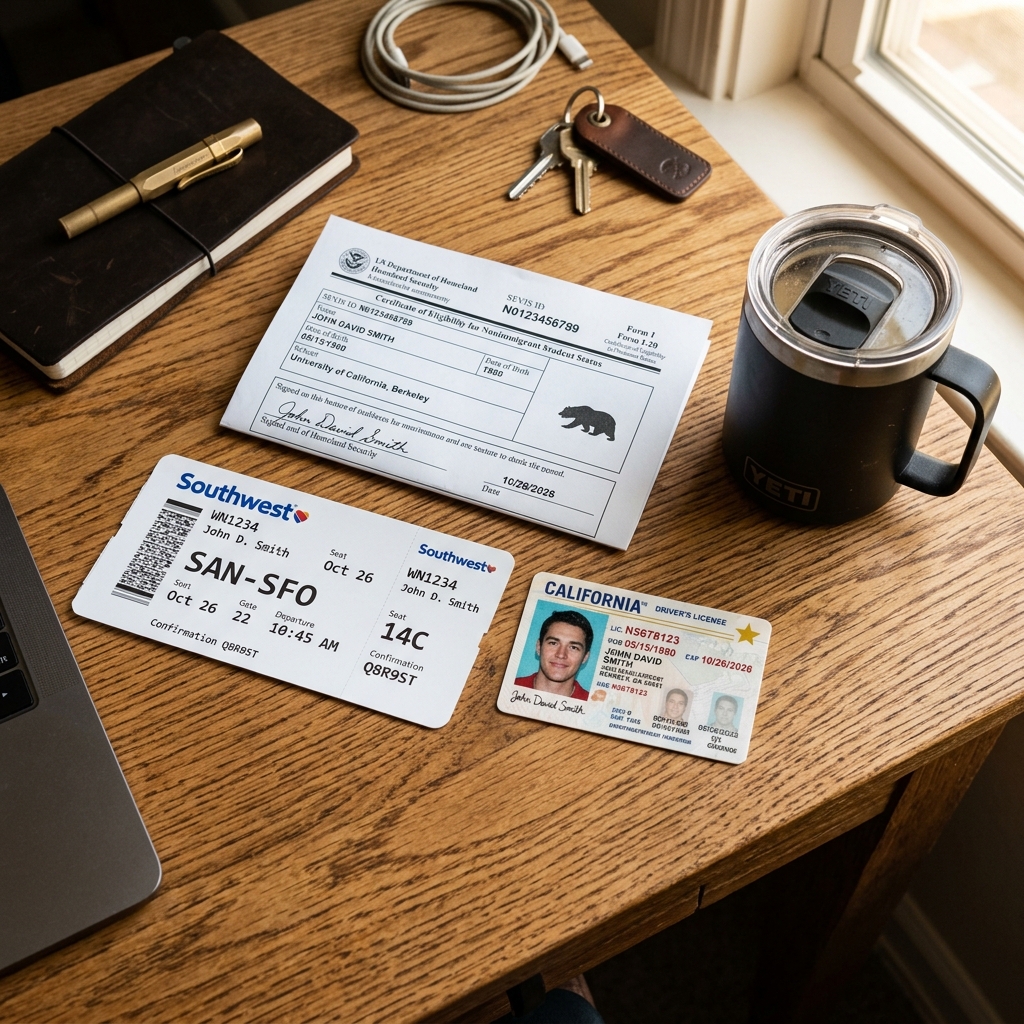
When flying internationally, the rules are obvious: bring your passport. But what about domestic flights? If you are an F-1 international student flying from Chicago to Miami, do you need to risk losing your passport at the beach, or can you just use a US driver's license? The answer depends entirely on the upcoming REAL ID deadline and your immigration status.
What is the REAL ID Act?
Passed by Congress after 9/11, the REAL ID Act establishes minimum security standards for state-issued driver's licenses. Starting on May 7, 2025, every traveler aged 18 or older will need a REAL ID-compliant driver's license (or another acceptable form of ID, like a passport) to pass through TSA security checkpoints for domestic flights.
You can tell if your driver's license is REAL ID-compliant by looking for a gold or black star in the top right corner.
Can F-1 Students Get a REAL ID?
Yes. As an international student on an F-1 visa (including OPT and STEM OPT), you are in a period of "lawful status" in the United States. Therefore, you are legally entitled to receive a REAL ID-compliant driver's license from your state DMV.
However, getting one requires bringing a stack of immigration paperwork to the DMV, including:
- Your unexpired foreign passport.
- Your most recent I-94 Arrival/Departure record.
- Your current I-20 (or EAD card if on OPT).
- Proof of your Social Security Number (or a letter from the SSA stating you are ineligible).
- Two proofs of physical residency (e.g., a utility bill and a bank statement).
The "Limited Term" Caveat
Because you are not a US citizen or Permanent Resident, your REAL ID will be marked as "Limited Term." This simply means the license will expire on the exact date your I-20 or EAD card expires. If you get a STEM OPT extension, you will have to go back to the DMV to extend your driver's license.
The TSA Checkpoint vs. Border Patrol
If you have a REAL ID, you can use it to pass through the TSA security checkpoint to board your domestic flight. TSA agents are not immigration officers. Their job is to verify your identity and ensure aviation security, not to check your visa status.
HOWEVER: US Customs and Border Protection (CBP) operates internal checkpoints within 100 miles of any US land or coastal border. Furthermore, CBP occasionally conducts random immigration sweeps at domestic airport terminals.
The Legal Requirement to Carry Documents
Under INA Section 264(e), every foreign national 18 years and older must carry their "registration documents" (I-94, Passport, and I-20/EAD) with them at all times. If you are stopped by a CBP officer or local police and you only have a US driver's license, they have the legal authority to detain you until they can verify your lawful status.
The TrackMyOPT Recommendation
Should you carry your original passport, I-20, and EAD card every time you fly from New York to Florida?
While the law says yes, many students are terrified of losing their passport on the beach. Here is the safest practical compromise:
- Use your REAL ID driver's license to quickly get through TSA security.
- Always carry your physical EAD card (if on OPT) or a physical copy of your most recent I-20 in your backpack.
- Use TrackMyOPT's Document Safe.
The TrackMyOPT Document Safe
If you are stopped by law enforcement or CBP and don't have your physical passport, having instant access to high-quality digital copies is your best defense against detention. By uploading your Passport, Visa stamp, I-94, I-20s, and EAD card to the TrackMyOPT Document Safe, you can instantly pull up your encrypted immigration file on your phone anywhere in the country.
Special Domestic Travel Zones
There are certain domestic flights where carrying your physical passport and valid I-20 is absolutely mandatory, even if you are just flying within the US:
- Puerto Rico and US Virgin Islands: While these are US territories and flights are considered domestic, CBP heavily patrols the airports. You will likely be asked to prove your immigration status before boarding your return flight to the mainland US.
- Hawaii and Alaska: If your flight is diverted and forced to land in Canada or Mexico, you will need your passport to re-enter the US.
Travel With Peace of Mind
Never panic at an airport again. With TrackMyOPT, you can securely store digital backups of every immigration document you own. Plus, our system automatically tracks your SEVIS reporting deadlines so you never accidentally fall out of status while on vacation.